

After months of discord, board to hear $11M armory proposal
If Riverhead Town Board members don’t agree on much, they at least agrees on this: The town needs a new location for its justice court.
But how to construct it, or where to put it, or how much the town should spend on it have remained topics of constant conversation at Town Hall in recent few months — with little, if any, common ground being established.
Supervisor Sean Walter hopes to put those concerns to rest today, Thursday, when board members are scheduled to hear a presentation by Cashin Associates and EGA Architects, two firms under contract with the town to draw up a plan and analysis for converting the vacant Route 58 armory into a justice court and police station. But, based on interviews with town officials over the past two weeks, it would be surprising to see the Town Board reach quick agreement on how, exactly, to move forward with any plan the consultants may present.
The $11.3 million price tag for the armory project,released two months ago, has some members of the all-Republican Town Board recoiling with sticker shock. Alternate plans have since been pitched by each council person, though none had any cost estimates in hand. Cashin’s presentation today will be the only plan the town has in writing — aside from the consultant’s $22 million estimate for building a completely new justice court and new police station, which doesn’t include the cost of the land.
•
In a town where developers have made plenty of headlines all on their own in recent years — from those eyeing Route 58 to suitors at the Enterprise Park at Calverton to businesspeople looking to change the landscape of downtown Riverhead — town leaders now find themselves in the interesting position of playing developer themselves as they seek a new space for the outdated justice court.
There are other lingering concerns as well, such as what to do with the little-used Henry Pfeifer building and worry that there is already more space available for town services than is needed.
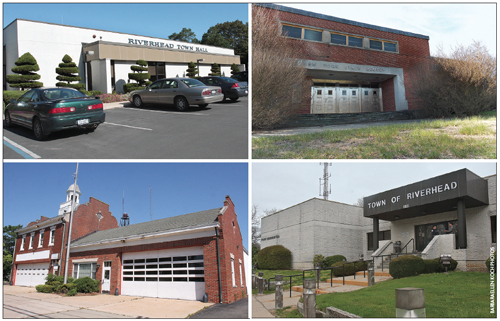
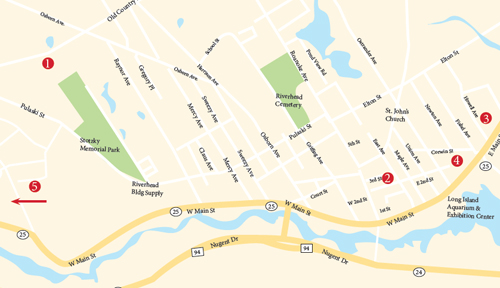
In addition to Town Hall and the justice court/police station building, Riverhead Town owns several buildings that have been at the heart of an ongoing debate about what town resources to place where.
• The East Lawn Building, also known as 542 East Main St., was built over 160 years ago. Located just east of the aquarium, it currently houses the Riverhead Chamber of Commerce, the Community Awareness Program, the town historian’s office and the Riverhead Housing Development Corporation.
• New York State deeded the armory to Riverhead Town in 2011 and the 5.7-acre lot on Route 58 has been vacant ever since. The state had acquired the building from Riverhead in the early 1950s with the stipulation that if it ever stopped being used as an armory, the town could get it back.
• Riverhead Town acquired the Second Street firehouse in 2011 through a land swap with the Riverhead Fire District for a parcel that abuts the armory property.
• Town Hall West, on Pulaski Street, was purchased for $2.8 million in 2009 and currently houses the town’s accounting, engineering and personnel departments
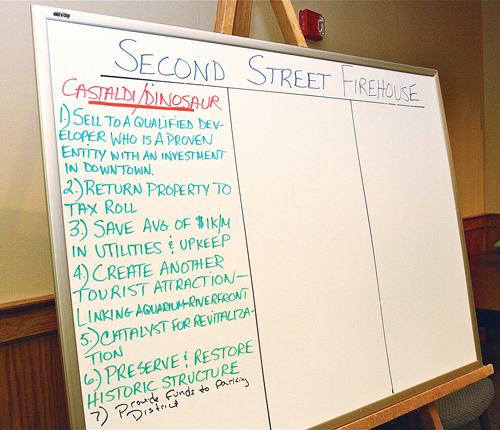
A much-publicized deal for the firehouse property fell through in February, after three members of the board, which had appeared to favor selling it to Suffolk Theater owner Bob Castaldi, switched their stance. Mr. Walter then took to local media to voice his theory that the change of heart had resulted from caucus meetings, or closed-door gatherings among Town Board members all of the same party permitted under open meetings laws.
While only potential political impacts of votes are supposed to be discussed at the meetings, the supervisor has been alleging otherwise.
“What happens, is they make public statements about what should happen on camera,” the supervisor said Monday. “And then they go to these secret caucus meetings and change their minds. It becomes very difficult to manage a town when they go behind closed doors and make decisions.”
But board members, each canvassed separately, have said they want to see what other options are on the table — and how much those options would cost — before moving forward with any plan for the future of the justice court and police department — or any other department, for that matter.
“We have to see the numbers first,” said Councilman George Gabrielsen. “We have to get all these numbers.”
•
Riverhead isn’t the only town in the area juggling real estate, deciding what to do with it and how it all fits into the community’s future. Over the past two years, the Town of Islip formed a space and consolidation committee tasked with assessing the town’s extra land — mostly undeveloped parcels such as parks department yards and public works lots — to bring in funds by getting the land on the tax rolls.
“The realization was a tremendous amount of surplus property,” said Islip’s deputy supervisor, Trish Bergin Weichbrodt.
The town completed appraisals for each parcel, put them up for sale and took in offers. Islip is currently in contract for $10 million in sales.
Similarly, Brookhaven Town leaders have sold over $2.5 million in excess real estate in the past year — all of it buildings in incorporated villages within the town’s borders.
“Within the villages, we should limit what we own,” said Supervisor Ed Romaine.
He said the town tries to line up buyers first, and then get an appraisal.
“As long as the offer meets the appraisal, that’s fine,” he said, explaining the process. “Are you willing to pay? OK then. It’s yours.”
In Southold, Supervisor Scott Russell said the town actually finds itself in an inverse situation from that of most others in Suffolk.
“The problem is we have fewer buildings than what our needs would be,” he said, adding that the town has been leasing space for several departments at a Capital One Bank branch in Southold.
Mr. Russell said the town’s space needs have been evaluated periodically by various town boards. Although more space would be nice, he said, now is not the time to buy land and infrastructure.
“We would like to retire some debt over the next year or two before the town takes on new debt,” he said.
•
Mr. Walter says that starting in 2017, anticipated debt reductions will be one of a couple of key factors that will help Riverhead afford the $11.3 million plan to relocate the justice court and police stations. He estimates that $700,000 to $800,000 in annual debt service will be retired by then, which would make the estimated $860,000 annual debt payments for the armory plan affordable, he said.
“It’s my responsibility to do this without increasing taxes on residents,” he said. In addition to a drop in debt, Mr. Walter is banking on future land sales at the Enterprise Park at Calverton.
“That will happen by [2017], without any doubt in my mind,” he said.
Other board members aren’t so sure.
Councilman John Dunleavy said last week that Mr. Walter “thinks he can sell a map,” pointing to the subdivision map currently in the works for the enterprise park.
The town paid consultants about $460,000 in 2011 to complete a study that will split the town-owned land at the former Grumman property into 48 different parcels of varying sizes. In tandem with state-sponsored “fast track” legislation that facilitates approval or denial of permit applications within 90 days, the supervisor has already hinted at EPCAL projects so large he can’t even talk about them in public.
Again, Mr. Dunleavy expressed skepticism.
“EPCAL is his savior,” he said. The councilman pointed to vacant commercial land still for sale farther west — in Yaphank, Ronkonkoma and Central Islip — that makes reliance on future revenue from EPCAL ill-advised. Rather than spending more than $11 million to renovate the armory,he sees a $4 million to $5 million project involving Town Hall, the justice court and police station as “a better course for the town.”
Mr. Gabrielsen said he would support roughly the same total cost mentioned by Mr. Dunleavy.
Rather than updating the entire armory, Mr. Gabrielsen said he’d like the town to explore the cost of renovating just a portion of it — say, only the first floor — and consolidating current Town Hall and Town Hall West offices there.
Mr. Walter said he’s open to the possibility of moving town offices to the armory, saying Riverhead’s spread-out operations are “fractured as a town organization. Accounting. Payroll. Purchasing. Engineers. They’re all across town. It’s not efficient government.”
The supervisor said if the town were to incorporate the Second Street firehouse or Town Hall into a future study involving moving the justice court and police station, he would again want to hire the Cashin/EGA firm.
But, he noted, the board’s recent disagreements about where to place town offices aren’t the best sign of things to come. He says the discord and wavering among board members about how to handle town buildings doesn’t bode well for getting EPCAL developed.
“If the Town Board can’t make decisions about simple things, like selling an old firehouse or selling the East Lawn Building, I’m really fearful about how they will react when they see the sheer magnitude of what we’re doing at EPCAL,” Mr. Walter said. “It’s very problematic at this point.”
Councilwoman Jodi Giglio said she’s not committing to anything until she knows the cost of renovating the Second Street firehouse. She has attempted to get a cost estimate for that work, but said Mr. Walter blocked town engineers from doing so, she said.
“Without that information, we can’t even think about” moving the justice court, or any other departments, she said. “We changed our minds on the firehouse when we found out it was going to cost $11.3 million to renovate the armory,” she added. “After that we wanted to take a step back and try to look at other options. We’re examining everything.”
Councilman James Wooten is the only one of the four council members to express openness to the $11.3 million armory renovation.
But if that doesn’t happen, he said, he won’t be an “obstructionist” to alternative ideas.
The former Riverhead police detective said if the town needs to wait a few years for the $11.3 million move to happen, he’d still favor that over rushing into another plan.
“I know everyone wants to look out for the taxpayer, but I think public safety really should be paramount,” Mr. Wooten said. “I think we can commit to [the armory], but wait until the timing is right.”
Mr. Wooten said getting everything, all options, out in the open is the only way to move forward.
“We’re going to have to compromise on a lot of issues,” he said. “I think the way to move forward is to have everybody put on the table what they’d like to see and let’s work together to get something done.”