

‘Border children’ reach Riverhead, reunite with family
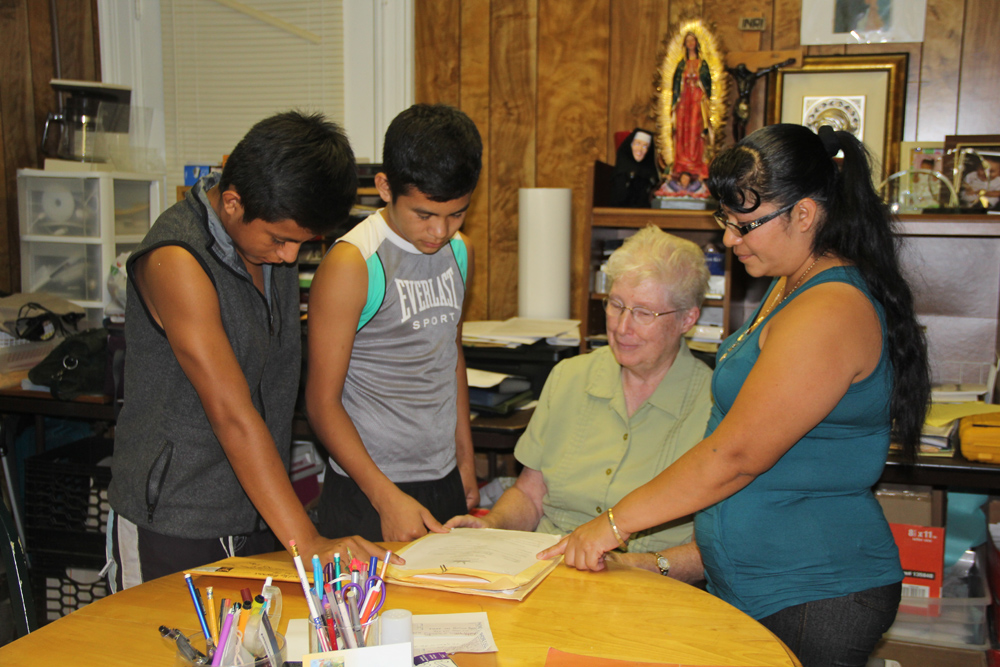
A misty Independence Day morning rekindled hope for a Riverhead family that was reunited for the first time in 11 years.
“I’m so happy,” said Marta, a Guatemalan immigrant who did not give her last name, in describing that morning. “Everything is different now.”
Her two sons, Estabon, 16, and Pedro, 14, were alive and well after completing a dangerous trip from Guatemala to Riverhead — without the helping hands of their parents.
The boys are just two of the thousands of young immigrants known as “border children,” who have been arriving unaccompanied at Mexico’s border, having fled their violence-plagued homelands in Central America.
Though the family remains reunited for now, the journey isn’t over, as immigration policy will determine whether they may stay united or will see their family split once more.
Over the past month, Sister Margaret Smyth of the North Fork Spanish Apostolate, who acted as a translator for the family during interviews on Tuesday, said she has been helping dozens of immigrant families on the North Fork who hope to be reunited with their children. Her duties include helping families file their fingerprints with the U.S. government and complete the necessary immigration paperwork, which consists of 12 pages per child.
“This is traumatic for these children,” Sister Margaret said of the long passage from Central America to the U.S., adding that she has helped about a dozen families reunite with unaccompanied children — some as young as 2 years old — within the past month. “Every one of them has a different experience.”
The children who survive the journey across the border but are intercepted by immigration officials are sent to shelters and centers nationwide. Estabon and Pedro were first cared for in California.
The boys said it took about a month for them to reach the U.S. During their time in California, they were shuttled among three different shelters within 19 days before their paperwork was processed and they were flown east to connect with their parents.
They realize, however, their newfound togetherness may be only temporary.
During a press address on July 9 in Dallas, Texas, where many such children are being sheltered, President Barack Obama warned parents across Central America not to send their kids northward.
“While we intend to do the right thing by these children, their parents need to know that this is an incredibly dangerous situation and it is unlikely that their children will be able to stay,” Mr. Obama said. “And I’ve asked parents across Central America not to put their children in harm’s way in this fashion.”
Along with paperwork and processing help, Sister Margaret said the Apostolate provides follow-up services to help children acclimate into the local community and get them enrolled in school, a requirement of federal law.
The families must also prepare for their future legal battles by retaining lawyers to fight to ensure their children can stay. The Apostolate helps in the legal matters, too. “As advocates, we are watching out for these parents,” Sister Margaret said.
During their passage through Mexico, Estabon and Pedro stayed in makeshift hotels or hostels, where they slept three to a bed to hide from sex traffickers seeking adolescents, Sister Margaret explained. The most trying part of the trip was navigating what the boys called “el Rio Bravo” or the Angry River — the Rio Grande.
The boys were two of a group of 20 adults and children crossing the river in a rubber raft.
“We were afraid someone might accidently poke a hole in our raft,” Estabon said. “If it happened, we would drown.”
According to the International Red Cross, the Rio Grande’s rough currents claim the lives of hundreds of border-crossers each year.
It was about 4 a.m. on the Fourth of July when the boys finally saw their parents, Marta and Mario, for the first time in 11 years. They also got to meet their 7-year-old sister, Katie, for the first time.
Congressman Tim Bishop (D- Southampton) said Estabon and Pedro were the first of the “border children” he had been informed of being reunited with family in his district, though said he was not surprised to hear some would find a home in the area.
Overall, he said, he anticipates “the number of kids coming to our area will be low,” but added that “without knowing the dimension of the problem and knowing where these children are settling,” it’s difficult to determine their impact on local school districts or services.
Riverhead school officials were unavailable for comment.
“This is a humanitarian crisis that I believe we have an obligation to deal with in a way that shows the compassion of the country, but at the same time respects the rule of law, making it clear we don’t have open borders,” Mr. Bishop said.
He also noted that “the law does not provide permission for unaccompanied minors to stay in the county indefinably.”
On July 8, President Obama asked Congress for $3.7 billion to help manage the flood of unaccompanied children arriving in U.S. from Central America.
“I support what the president has requested,” Mr. Bishop said, adding that Congress is expected to make modifications to the request.
“There is speculation they will cut it in half,” he said.
According to the Obama administration, more than 50,000 unaccompanied children have entered the U.S. since October.