

Real Estate: How a family saved a historic Cape Cod
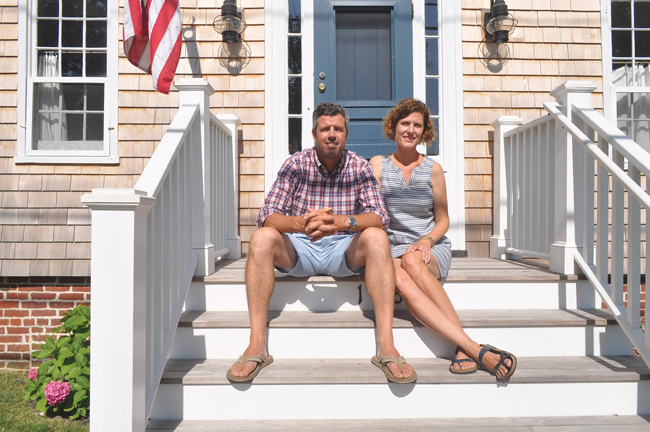
On picture-postcard-pretty Village Lane in Orient, residents worried not long ago about the fate of one of the street’s genuine treasures — a simple but handsome Cape Cod house that may date as far back as the 1700s.
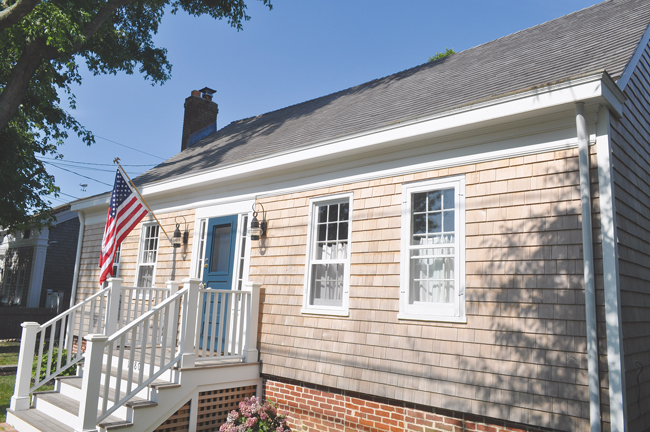
Neighbors watched with dismay as the front stoop of the house at No. 1780, in the heart of the hamlet’s prized National Historic District, disintegrated — one of them repaired it gratis — and a covered porch tilted so precariously that the owner had to remove it. They saw asphalt shingles on the roof that had totally lost their shape and a peeling exterior paint job that signaled “dwelling in distress.”
“Most people would look at it and say it’s a teardown,” recalled James Garretson, a Village Lane resident and architect who’s vice-chairman of the town’s Landmarks Preservation Commission.
Indeed, rumors circulated that someone wanted to buy the house and demolish it in order to run a driveway through the property.
The house immediately to the north had already been demolished and replaced, to the consternation of many residents, although that occurred before the establishment of the landmarks commission. (Now, a property owner in the historic district must prove to the panel that a structure is unsalvageable before being allowed to demolish it.)
As it happens, however, 1780 Village Lane, described by Orient’s Oysterponds Historical Society as a “five-bay story-and-a-half Cape Cod,” experienced a much better fate.
That’s because David Terry, who inherited the house from his mother but lacked the resources to restore it as he would have liked, sold it in late 2012 to Alison and Michael Ventura, who had the wherewithal and, by all accounts, the good taste to transform it into a residence befitting Orient’s lovely Village Lane.
When the Venturas, now both 41, first saw the bedraggled dwelling in the spring of 2012, with its “For Sale by Owner” sign, Mr. Ventura said recently, “I thought, ‘No way.’ It was beyond consideration.”
But consideration came quickly — very quickly. “By the time we had reached the end of Village Lane, we had already called the owner,” added Ms. Ventura. The house’s fine lines and its proximity to Orient Wharf, just a few hundred feet away, had captivated them.
Still, the couple, who also live in Westchester County, were wary enough about the property that they weighed purchasing it for four months before going to contract.
What convinced them to proceed was the enthusiastic endorsement of the house’s structural integrity by Robert Sorenson, an Orient contractor specializing in restoring old homes.
“It’s such a historic gem,” said Mr. Sorenson, who would become the Venturas’ general contractor. “When you have joists [parallel beams set from wall to wall] with bark on them, that tells me it’s probably built in the 1700s.”
Mr. Ventura, a portfolio manager at a bank in Manhattan, credits his wife with having an appreciation for how special their house is — which isn’t surprising given her professional and educational background.
Ms. Ventura, who once designed exhibitions for the Smithsonian Institution in Washington, D.C., holds a master’s in decorative arts and design history from Parsons The New School for Design in New York City.
Restoration of the house began early last year with work to stabilize it. This included excavating around the original stone foundation so that it could be repointed. (It underlies a high brick foundation that, according to the Oysterponds Historical Society, was added in the 1880s, when the house was raised as protection against flooding in this low-lying part of Village Lane near Orient Harbor.)
To further stabilize the house, additional joists were installed to supplement the original beams, which the Venturas have preserved for historical reasons, and two dozen new wooden support columns made were inserted in the basement to replace old metal posts that had corroded because of saltwater intrusion.
By the time the couple moved into their four-bedroom house in June 2013 with their twins, Augusta and Michael, now age 9, the exterior restoration of the house, which received new cedar shingles on both roof and sides, was complete. Inside, however, their home was still “a mess,” Ms. Ventura recalled.
It’s gotten steadily better since then.
Both bathrooms have been completely redone and a new ducted, forced-air heating system has just been installed. But “we didn’t do much to the kitchen,” said Ms. Ventura as she led a visitor into a cheerful space with windows on three sides. The eat-in kitchen is believed to date from the late 1800s.
The recently repainted living room is especially attractive because it has an unusually high ceiling for a Cape; Mr. Sorenson estimates that it’s “every bit of eight feet” high — about a foot more than normal.
If the Venturas are pleased with their restoration, so are their neighbors.
“They really improved the consistency and quality of Village Lane,” said Bill Matassoni, who owns a beautifully restored circa-1730 house two doors away. “Every house on Village Lane now looks good.”
Another Village Lane resident, Janet Markarian of Daniel Gale Sothe
by’s International Realty, who ended up selling the house for Mr. Terry, said the Venturas did such a fine job restoring it that some prospective buyers to whom she had shown the house regretted not purchasing it.
“People really liked it, but they were afraid,” said Ms. Markarian. “For the Venturas, it was a leap of faith.”
Now a Cutchogue resident, Mr. Terry, whose family acquired the property in the 1960s, is also pleased. His old home “looks a lot nicer,” said Mr. Terry, who still has a vintage 1930s oil painting of the house by prominent Orient artist William Steeple Davis. “I’m happy they found someone who enjoys old houses.”
No. 1780 is just one of several very old houses on lower Village Lane. Besides the Matassonis’ there are two homes said to date to 1845, another to the mid-1750s and one, described by the historical society as the best documented, to 1701.
Mr. Ventura believes his newly restored home will be around for a lot longer. “Now the house is good for another couple of hundred years,” he said, smiling broadly.