

EPCAL plan blasted for housing, retail components
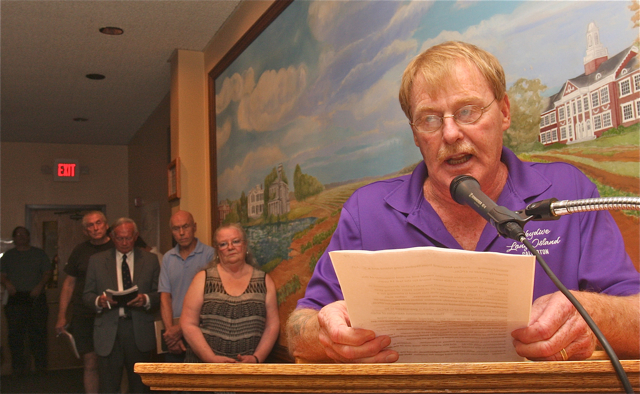
The thought of placing housing and retail uses at the Enterprise Park at Calverton weren’t very popular at a public hearing Wednesday night on Riverhead Town’s reuse plan for the former Grumman site.
In fact, the entire plan, and the environmental impact study of that plan, weren’t popular at all with the 19 speakers at the hearing, as almost all of them found something to criticize in the plan.
The proposed EPCAL “reuse and revitalization plan” drawn up by VHB Engineering and Planning at a cost of over $600,000 is an update of the reuse plan adopted in 1998, when the town first took ownership of EPCAL from the Navy, and calls for a 50-lot subdivision with “mixed-use” development, consisting of light industrial, business, residential and retail uses on nearly 600 acres of the 2,400-acre property.
Click here to read last night’s live coverage from the public hearing
More than 1,300 acres of the town-owned property would remain undeveloped, including the western air strip, which is proposed to be turned into grassland.
The housing and retail components are meant to be in support of the industrial uses, meaning that the people working at the businesses in EPCAL would ideally live there too, and shop at stores that would be on the EPCAL campus. This would reduce the strains on local roads, which the study says will not be able to handle the future traffic generated at EPCAL.
But businesspeople, environmentalists, civic group leaders, and town residents who attended the two-hour-long meeting on Wednesday night weren’t buying it.
“In all of my professional life, I have been chased from residential communities because of my business, and we have willingly moved because of the pressures that have been put on us by residential land growing up around us,” said Edgar Goodale of Riverhead Building Supply, which has several buildings at EPCAL, who said they oppose the proposed mixed use development.
“I’m looking down the road and finding myself right back where I started,” he said. “This is an industrial park and it should remain an industrial park.”
Mr. Goodale also said the town’s ability to lure industrial companies to EPCAL — in current and past administrations — has been “flawed.”
“I’ve talked to numerous people who come to this town to visualize moving their businesses here, and after speaking with various town boards and town officials, they cannot run away fast enough,” Mr. Goodale said.
Ray Maynard of SkyDive Long Island, which is the only aviation use currently at EPCAL, also opposed allowing housing there.
“I can’t believe the board is considering a subdivision that will be detrimental to my business,” he said.
“EPCAL has become the place where bad ideas come to die,” said Richard Amper of the Long Island Pine Barrens Society, referencing a string of prior proposals for EPCAL, including a motion picture studio, NASCAR track, jetport, and indoor ski mountain.
“Administration after administration has blamed the incapacity to make EPCAL profitable on salamanders, birds or environmentalists in general,” he said. “It’s become increasingly clear that the real reason EPCAL hasn’t been developed is the incompetence of Riverhead government itself.”
Mr. Amper said the current plan calls for 25,000 permanent jobs by 2035, even though the town population is only 34,000.
“For years, all of the experts said EPCAL could only be successful if used for commercial and industrial purposes,” Mr. Amper said. “Now, residential and retail have been thrown into the mix. There’s no justification for it.”
Bob DeLuca of Group for the East End said the impact study failed to identify how roadway improvements necessitated by the EPCAL development would be paid and who would pay for them.
Former Congressman George Hochbrueckner, who was the congressman who first proposed turning the former Navy site over to the town to provide economic developer to offset the loss of Grumman in the mid-1990s, objected to the plan to turn the unused western runway into grassland. He urged the board to allow a Virgian company called HelioSage Energy to lease the runway for 20 years in order to put 20 megawatts of solar energy panels on it. Mr. Hochbrueckner, who said he was “approached” by HelioSage to represent them, said that company has put in an application with LIPA to do so, in response to LIPA’s request for proposals for solar energy.
“Otherwise, the DEC (state Department of Environmental Conservation) will make you cover the runway and plant grasses on it, and that will cost you over $1 million,” Mr. Hochbrueckner said. “It was never our intention to make that land a burden to you. You were supposed to make money with it.”
The former congressman, who worked as a consultant for the town last year on EPCAL issues, offered his services at no cost to the town to work with DEC on allowing solar energy.
He said if other solar companies want to submit proposals for the site, “Fine, have a competition.”
After the meeting, Supervisor Sean Walter said that the only reason the town studied residential development at EPCAL was because council members Jodi Giglio, Jim Wooten and John Dunleavy supported a proposal from a polo company that called for housing.
“That’s why it was studied,” he said. “It’s not a deal breaker for me. I was pretty consistent (in opposing housing at EPCAL) up until recently, when I decided you really could have some residential if you do a high-tech park, but not single-family housing.”
Still, he said mixed use developments are what the market is looking for nowadays.
“If the company comes in and says they want to bring in 1,000 employees and they would like a couple hundred units of transitional housing for these employees, we’re not talking about single-family housing,” Mr. Walter said. “I’m talking about dormitory or transitional homes. You only have to look at Brookhaven Lab, where 10 miles down the road, they have 550 units of housing and they are trying to build more.”
Likewise, he said that if there are 5,000 employees at EPCAL, there aren’t enough places for them to eat in Calverton and Wading River.
The EPCAL study predicts that by 2025, the proposed new zoning would result in 289,606 square feet of industrial and research development, 1.3 million square feet of office space, 385,785 square feet of commercial and retail space and 150 units of residential development.
By 2035, the study anticipates those numbers at 538,667 square feet of industrial and research development; 2.47 million square feet of office and industrial space; 667,340 square feet of commercial and retail space and 300 residential units.