

Cuomo proposes new teacher rating system
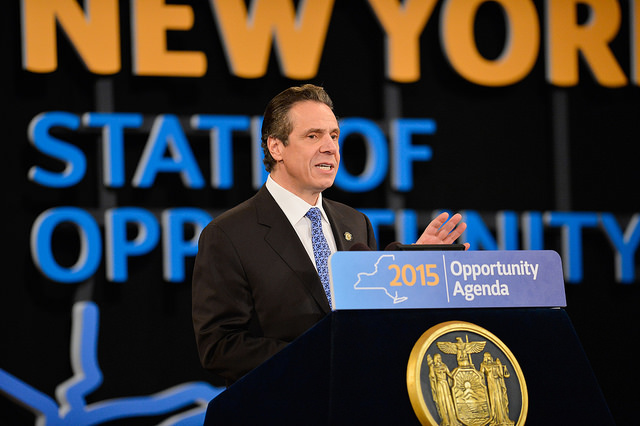
During his annual State of the State address earlier this month, Gov. Andrew Cuomo outlined a 66-part presentation he dubbed New York’s “Opportunity Agenda.”
Split into five separate platforms including justice, economic opportunity, education, public safety and government reform, Mr. Cuomo said singling out the agenda’s individual items — something he hasn’t done before — allows people to explore each concept more thoroughly.
“The State of the State is basically an announcement of policy themes that we’re going to pursue for that year,” he said. “We’ve dealt with many complex problems we’ve been trying to solve for a very long time. It takes time to understand what they are and really work your way through them.”
Whether state legislators agree with Mr. Cuomo’s solutions remains to be seen, since his proposals still have to pass through both houses in Albany.
We’ve picked out a few of those 66 “Opportunity Agenda” items on these pages. Take a look at the rest by going to governor.ny.gov/news/2015-opportunity-agenda.
EDUCATION
Mr. Cuomo proposed a new teacher rating system that would base 50 percent of an instructor’s evaluation on student test scores — an increase from 20 percent.
The governor said the change is needed because less than one percent of teachers were rated ineffective (the lowest category on the rating system) last year but students continued to “lag behind in performance.”
If the system were to go into effect, teachers would also need to achieve five consecutive years of effective ratings before being granted tenure, Mr. Cuomo said. Other proposals he discussed include passing the DREAM Act, increasing the state’s number of charter schools and expanding pre-K.
If the Legislature passes his education reforms, Mr. Cuomo said he’ll approve a 4.8 percent increase, or $1.1 billion, in school aid.
Although Riverhead Superintendent Nancy Carney agrees that assessments are a valuable way to measure student achievement, she described the state’s system as “unreliable.” She added that it lacks a plan for evaluating ESL (English as a second language) students and students with disabilities.
“Giving all students the same assessment regardless of their proficiency in the English language or on their developmental level yields a false picture of student achievement,” Ms. Carney said. “I am continually disappointed in the state for not recognizing this obvious problem in a ‘one-size fits all’ approach to student assessments.”
Mattituck-Cutchogue Superintendent Anne Smith said the district “takes assessments seriously and administers them with fidelity” and uses the results to help evaluate teacher performance and student academic growth.
Still, she said concerns over the state’s system are valid.
“Students are currently assessed as if they had been engaged with the current standards for several years,” Ms. Smith said. “It is simply too soon to use results of an assessment that is clearly under construction.”
JUSTICE
As part of his “Fairness for All” platform, Gov. Andrew Cuomo offered five specific proposals, including one designed to “restore trust between community and law enforcement.”
But local police chiefs say there isn’t much trust lacking that needs to be restored, although an effort to enhance police officers’ standing in the community is never a bad thing. Improved relations between law enforcement and the public would require several distinct but related initiatives, according to the governor.
Those include hiring more minorities in law enforcement, funding more bulletproof glass and vests, a broader use of body cameras and making data available regarding race and police actions.
Riverhead Police Chief David Hegermiller said funding for body cameras has been an issue, but noted that they could be “good for everyone, because they document exactly what happened.”
He added that hiring more minorities within the department — in a town where 14 percent of the population is Hispanic — is something “I totally agree with.” However, he said, few Hispanics take the requisite test to join the force, making it difficult to hire them.
In Southold, Chief Martin Flatley praised efforts to provide more bulletproof vests for local departments, noting that his department recently used a state program to help cover the cost of bulletproof vests for eight new hires.
He isn’t sold on body cameras — at least not at this point — but said he’d “be watching closely the level of successes/failures that departments will be experiencing.”