

Riverhead continuing to invest in security; 27% increase proposed
A video surveillance system that police and fire departments can view in real time during emergencies. Security cameras on buses. An identification scanner checking for convicted sex offenders.
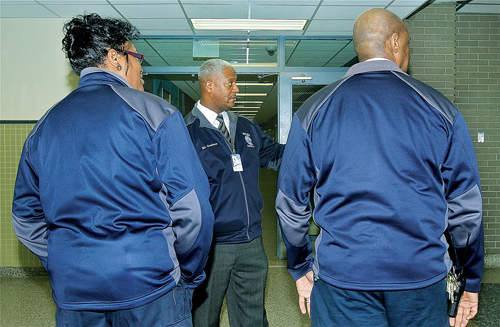
These are just some of the latest security features operating in the Riverhead school district and spearheaded by a security director who was hired just last year.
And even more improvements are on the way.
Superintendent Nancy Carney is proposing a 27 percent increase in the school district’s security budget for next year, boosting it by $242,600 to about $1.13 million. Although that represents just a fraction of the district’s overall budget — which last year surpassed $120 million — it signals a concerted effort to improve security systems within the district.
“It’s all about prevention and preparedness,” Ms. Carney said.
Although most of the recent enhancements to district security occurred in the two years following the 2012 shootings at Sandy Hook Elementary School in Newtown, Conn., Ms. Carney said the added investment isn’t a direct outgrowth of that tragedy. In fact, the superintendent said, the improved security measures have been a priority of both the district and school board for the last several years and safety upgrades were built into the $78 million construction bond approved in 2011 by Riverhead school district voters.
The district’s new security director, James Gresham, was hired in October. Ms. Carney hopes to hire two additional security guards next year from the school’s general fund and said the district plans to expand its state-of-the art video surveillance program, known as Project Safeguard.
The district had 20 security guards for several years, but four of them were laid of in the 2011-12 school year, when the state-mandated tax cap took effect. Those guards have not been replaced, the superintendent said.
In her 2015-16 budget proposal, Ms. Carney included $90,000 for additional cameras and recording equipment — an expense she said is necessary in order to replace as many existing security cameras as possible with upgraded digital equipment.
“Without the recording equipment, the cameras are not very useful,” she said. “It is my hope that within several years, the entire district will be upgraded to modern digital camera technology.”
Mr. Gresham, who previously worked in security for over a decade in the Wyandanch and Southampton school districts, said Project Safeguard was designed by the same creators of Homeland Security’s digital surveillance system and described the version for schools as a “scaled-down” model of the type used by the federal government.
“When we have professionals — whether police or firemen — looking into our situation, this gives them real-time information,” he said. “We never had that before. It’s cutting down on the response time and, when they get here, they’re able to organize a much better evacuation or, in the case of a school shooter, neutralize the perp that comes into the building.”
Project Safeguard was first installed at the high school in 2013 and has since been expanded to the middle school. Ms. Carney’s proposed security budget for 2015-16 — which will go to a vote in May — includes funding to expand it to Pulaski Street School as well as additional areas built during the high school and middle school’s recent expansion projects, she said.
“Security starts at the front door,” Mr. Gresham said. “If we’re aware of issues at the front door, then we’re better able to manage and assess the situation. With this system, we don’t have to rely on anyone’s memory.”
Riverhead isn’t alone in boosting its security expenses in recent years.
The market research firm IHS Technologies reported last year that spending for school security systems is expected to hit $4.9 billion nationwide in 2017, up from $2.7 billion in 2012.
According to a Dec. 27, 2014, article in The New York Times, schools across the country have increased security spending over the last two years for familiar equipment like “surveillance cameras, panic buttons and key-card entry systems,” as well as newer technology, including “bulletproof whiteboards to help teachers shield students inside classrooms and a smartphone app that starts a school lockdown with the swipe of a finger.”
On Friday, the Sandy Hook Commission created by Connecticut Gov. Dannel Malloy released its final report about current polices and recommendations to state officials. Topics addressed in the 277-report include mental and behavioral health services, school design standards and law enforcement, public safety and emergency response, among others.
During its Feb. 24 meeting, the Riverhead school board approved a $22,300 contract for BadgePass Visitor Manager Solution, a system that ID’s visitors, keeps track of their visits and can alert a guard to visitors who are convicted sex offenders.
Another feature allows the district to input orders of protection or court orders to make sure students aren’t picked up from school by someone they shouldn’t be with, Mr. Gresham said.
“If a person doesn’t belong in our building, for whatever reason, it won’t allow you to print them a badge,” he said.
Mr. Gresham estimates the system will be installed districtwide in about six weeks.
When asked if metal detectors have been discussed, Ms. Carney said that type of equipment isn’t currently part of the district’s security plan because it hasn’t been identified as a need.
As for buses, Ms. Carney said a handful of cameras were installed this year as part of a pilot program to make sure the two systems are technically compatible.
“The cameras are costly — about $2,000 each — and it will take time for us to outfit every bus with camera technology,” she said.
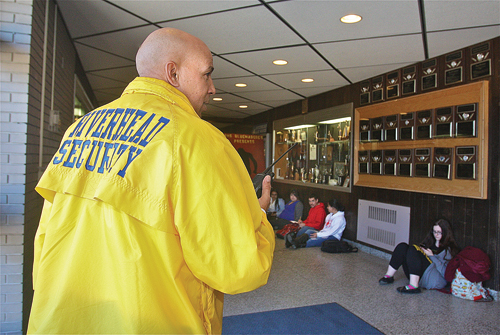
In addition to the investments in technology, Mr. Gresham said described his staff as the district’s “first responders” and said they act as liaisons between students and support services, such as guidance counselors.
“Our approach is to make students feel good about us and let them know they can bring us their issues and problems and stop them from growing into altercations,” he said.