

15-year-old Jack Crowley’s survival story is helping save others
As a general rule, people who have died do not hold conversations very well.
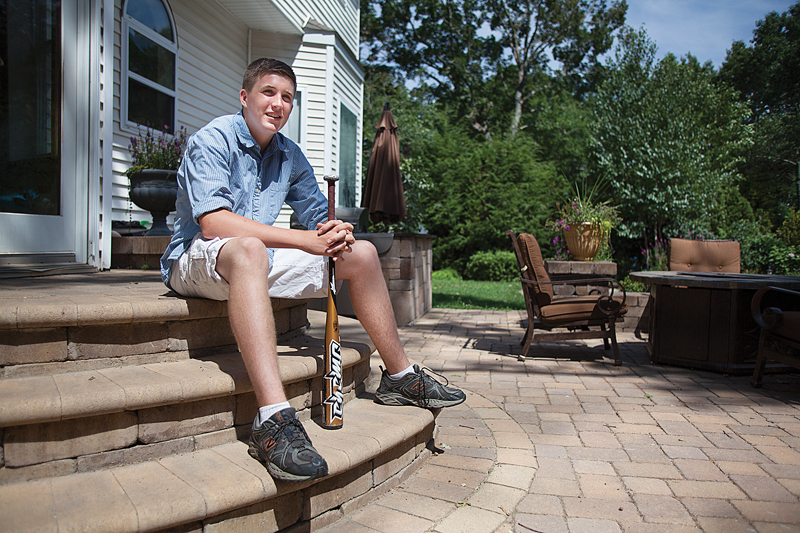
Shoreham-Wading River High School sophomore Jack Crowley is an exception: The 15-year-old speaks with the verve and confidence of someone twice his age, constantly maintaining eye contact with his interlocutors. He is energetic and warm; a teenager who devoutly loves the Yankees yet openly admits that Fenway Park is kind of cool … sometimes.
On May 9, though, that energy almost slipped away. While playing around in the batting cages during his youngest brother’s baseball game, a zipping baseball struck Jack in the chest. His heart stopped and he could not breathe.
Jack was technically dead until an off-duty police officer revived him with an automatic external defibrillator.
Now, just over three months later, Jack is back on the baseball field and moving past his ordeal — though his mother certainly worries more now.
And Jack, a talkative, charming young man who is equally comfortable on the baseball field or talking at the front of a room, is expanding his experience to others. He has been a symbol for the community’s request: Purchase more AED machines and have them available at every school athletic event.
“I guess I’m alive for a reason, so I’ve got to make something of it,” he said.
For the split second before the ball hit him, it looked like an innocuous line drive.
Jack, the oldest of the three Crowley boys, was visiting the North Shore Little League baseball facility in Rocky Point with his mother and two brothers on that fateful May afternoon. His mother, Nancy, was watching her youngest son, Owen, in his game.
Meanwhile, Jack and Aidan, the 13-year-old middle brother, went to the batting cages to get in some time of their own. Those cages have no machines, so the two played the old-fashioned way: Jack, who splits his time between third base and pitcher, threw from behind a screen while Aidan practiced hitting.
Everything changed in an instant. Jack stepped out from behind the screen to pick up a ball and threw it to Aidan in one motion, a gesture more for fun than anything. He did not expect the ball to come right back at him.
Jack, who has been playing baseball for most of his life, thinks he should have caught that ball.
He didn’t.
“[Aidan] hit it right back into my chest,” Jack recalled. “For the first few seconds, I felt like I was fine. I’ve been hit by a ball hundreds of times before.”
Aidan froze and watched his brother. Jack staggered for a moment, then he fell.
“All of a sudden, I couldn’t breathe at all,” he said. “I started feeling really light-headed, and then I went to my knees. That’s when I blacked out.”
Jack doesn’t remember much about the experience after his heart stopped. He knows he fell to his knees, but he doesn’t recall falling onto his back.
In another part of the baseball complex, Ms. Crowley was watching Owen play when a friend came to find her with fear in his eyes. Immediately, she knew something was wrong.
She was at Jack’s side within 90 seconds.
“He was so blue so quickly,” she said. “You knew he wasn’t able to get any oxygen.”
Jack’s head was bleeding because he’d suffered turf burn during his fall, and his eyes remained open and glassy while he lay on the ground.
“I kept focusing on his eyes because I felt like I might never see them open again,” Ms. Crowley said. “A mother should never see her kid like that.”
Retired police officer Chris Baumeister of Shoreham, whose two sons are best friends with Aidan and Owen, went to get help. He had sensed the same severity from years of tragedy witnessed in the line of duty.
“I heard the yell from John [Crowley] and his wife,” he recalled, “the scream I’ve heard too many times at work that means: ‘My kid is dying here.’ ”
In those brief moments, which felt like an eternity, Ms. Crowley thought of another teen from Shoreham-Wading River: Thomas Cutinella.
Tom was a junior playing his first year of varsity football for the school team. During an Oct. 1, 2014, game between Shoreham and Elwood/John Glenn, he went into a block on a simple running play.
Right after the play, he stumbled and then fell to the field just a few feet from the sideline. He died in the hospital a few hours later of a head injury sustained in that play.
Tom’s death devastated the Shoreham-Wading River community. Vigils drew hundreds of people, and his funeral service had to be broadcast over loudspeakers to attendees outside the church. Shoreham went on to win that year’s county championship after an undefeated season, and a new turf field will be named in Tom’s honor.
Seven months after that tragedy, another one almost befell the district.
“We all grieved terribly for [Tom],” Ms. Crowley said. “[When Jack fell], it was like a collective scream: ‘No, no, we can’t do that again.’ ”
Jack did not die that day, though, at least not truly. Mr. Baumeister called first responders and then remembered there was an AED present.
An AED could not have saved Tom, but the machine did save Jack.
Right after the shock jump-started his heart, Jack began speaking. He asserted that he was fine and asked to go home.
“It was scary, but I really didn’t know what was going on,” he said. “At first, I had no idea what had happened.
An ambulance took him to St. Charles Hospital in Port Jefferson, which then transferred him to Stony Brook University Hospital so his heart could be monitored. With the appetite of a 15-year-old athlete, he asked the ambulance driver if they could stop at McDonald’s on the way.
Jack stayed in the hospital for two nights. Then, doctors told him to keep his heart rate down — akin to prison for a teenager who lives and breathes activity — for six weeks to ensure that his heart did not suffer long-term damage.
“It was the longest six weeks of my life,” he sighed.
Jack suffered commotio cordis in the incident, a condition in which blunt force impact to the chest stops the heart without actually damaging it.
For that to occur, according to a 2012 study, a perfect storm is needed: a small, dense object — in this case, a baseball, though it could be a hockey puck or even an elbow — needs to strike the left side of the chest right near the cardiac silhouette at speeds between 30 and 40 mph during an extremely narrow window of time.
The heart is most at risk during its T-wave, when it is refilling its ventricles with blood. If the impact occurs within a 40-millisecond period between the start of the T-wave and the peak of the T-wave, the force can offset the heart’s rhythm enough for it to stop working.
So Jack was, by all means, in the wrong place at the wrong time. If he’d been standing two inches farther to his right, the ball could have skimmed his ribs. If he’d been two feet farther back, the ball could have hit his chest plate at a moment in his heart’s cycle that did not induce cardiac arrest.
And yet such a condition is not nearly as rare as its virtually infinitesimal prerequisites would indicate: A 2007 study found that more than 180 cases of commotio cordis have been reported since 1996. Karen Acompora of Northport, whose foundation works to prevent sudden cardiac arrests in young athletes, estimates that number is now closer to 280.
Commotio cordis killed Ms. Acompora’s 14-year-old son, Louis, back in 2000 after a lacrosse ball struck him in the chest during his first high school game. There was no AED present, and Ms. Acompora believes one would have saved Louis.
Adolescent boys like Jack and Louis are particularly at risk, partially because of the sports they play and partially because their chest walls have not fully hardened at that age, according to a 2009 study by Tufts University researchers.
As a result of her loss, Ms. Acompora started the Louis Acompora Memorial Foundation and has spent years advocating for greater awareness and AED ownership, so she was particularly relieved to see Jack’s success story. The foundation’s website says it has saved 87 lives from sudden cardiac arrest since being founded.
“We get joy out of the fact that these kids aren’t dying — they’re being saved,” she said. “Obviously, I wish someone had done it for us and our family, but you move forward.”
Jack knows how lucky he is.
“It’s made me love life a little more,” he said.
His near-death experience sparked action in the Shoreham-Wading River community. Less than one week after Jack’s heart stopped and started again, local surgeon Marc Dinowitz implored the district’s Board of Education to improve its AED policies.
Since then, he has submitted a formal proposal to Section XI along with Ms. Acompora, and the district is now formally considering purchasing 30 to 40 additional AEDs at a cost of $40,000 to $60,000.
The Crowleys attended a July 28 board meeting to support the push, and Jack received a standing ovation.
“He was so lucky that everybody did the right thing,” Ms. Crowley said. “I understand [AEDs] are costly, but they’re worth a little bit more than soccer nets and new uniforms.”
Timing in a case of commotio cordis is critical, which is why proponents of AEDs want the school to have them present at all events. The Tufts study found that when a defibrillator was used within the first three minutes, patients had a 25 percent survival rate. After that three-minute window, however, the chances of survival drop to 3 percent.
“People think that just because they have an AED at the school, it’s going to be enough,” Ms. Crowley said. “It’s not enough when you’re way out in those fields.”
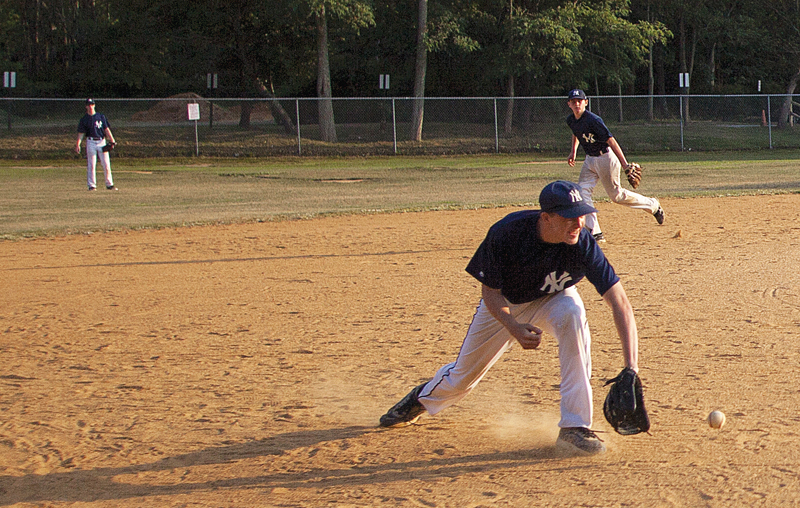
It’s impossible to keep a teenager that energetic subdued for very long. The first day Jack was cleared to resume physical activity, he went for a run and, within a week, he was playing in a baseball game at the same complex where he died.
So far, he does not feel nervous pitching, though he will not throw to a batter in that same cage where his heart stopped because he feels it is too small for safety.
“You don’t have time to react,” he said.
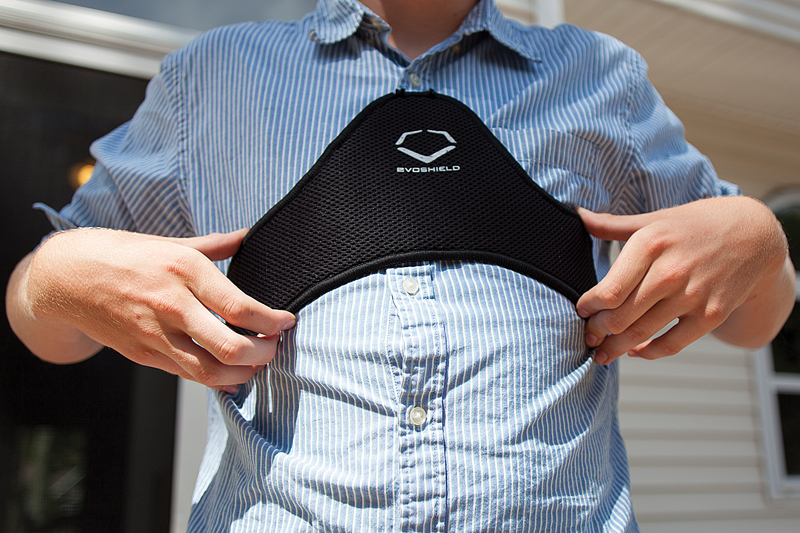
All three Crowley boys and all of their friends have started wearing Evoshield heart guards — small, hard plastic pieces that are placed into a special shirt and conform to the wearer’s chest.
Jack admits there’s no evidence that the guards work, but he decided he might as well wear it anyway.
He tries not to think about his almost-tragedy, but his mother remembers it “constantly.”
“I’m still not completely comfortable, but this is their love,” she said. “I would bubble-wrap him if I could, but I don’t think I’m going to get away with that.”
The very first day he resumed playing, Jack was pitching. He threw one over the plate, and the ball rocketed off the bat right back at him. This time, there was a different ending.